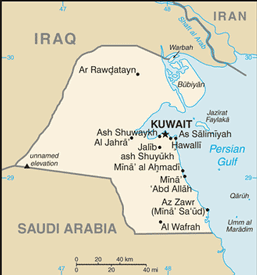
Showing posts with label Kuwait. Show all posts

Saturday, October 22, 2016

Kuwaiti's Emir dissolves parliament paving way for elections

The emir of Kuwait, Sheikh Sabah al-Ahmad Sabah, has issued a decree today dissolving the Kuwaiti National Assembly, according to the official state news agency KUNA.

The dissolution sets the stage for an early election. The dissolution was announced after an emergency government meeting. The emir said that because of the circumstances in the region and security challenges, that he had ordered that the 50-member legislature be dissolved. The emir's move comes less than 24 hours after the speaker of the parliament Marzouk al-Ghanem called for new elections in the face of security and economic challenges.
Kuwait is a constitutional monarchy with the emir having power to appoint the PM who appoints government ministers but compared to most other Gulf Cooperation Council states it is more liberal and the legislature has considerable power. A BBC article claims:Kuwait's parliament has the most powers of any elected body in the Gulf region, but the ruling al-Sabah family has the final word over all key decisions and has dissolved the legislature repeatedly in the past.Kuwait shares borders with Iraq and Saudi Arabia. As of 2014 it had a population of 4.2 million people but only 1.3 million are Kuwaitis with 2.9 million being expatriates.
The cabinet also resigned after the parliament was dissolved. There has been a dispute between the government and the parliament over price increases in fuel in the country. However, there are also claims of administrative and financial violations. Although no date was set for the new elections, the constitution says that they must take place within two months of the parliament being dissolved. The country faces declining revenues as oil prices have dropped leading to the government to cut back on the many subsidies enjoyed by Kuwaiti residents. This has stirred a popular backlash. Kuwait is a major oil producer.
Recently Kuwait has had attacks by the Islamic State(IS). On October 8 an Egyptian IS supporter drove a garbage truck loaded with explosives into a truck carrying five U.S. soldiers but the attack ended up just wounding the attacker. However in 2015 IS carried out a suicide bombing of a Shia mosque that killed 27 and wounded scores more.


Sunday, July 17, 2016

US expects $40 billion in foreign military sales this fiscal year.

For the fiscal year ending on October 1, 2016, the U.S. is on track to rack up $40 billion in foreign military sales. Exports sales are down from $46.6 billion last year, according to a top Pentagon official.

U.S. Navy Vice Admiral, Joe Rixey, head of the Pentagon Defense Security Cooperation Agency (DSCA) provided the statistics at the Farnborough International Airshow, saying: "We're tracking toward $40 billion. We're tracking toward our forecast. " While Rixey admitted that the total still could be different depending on what happens in the fourth quarter, Rixey did not think the Brexit will change U.S. sales to the UK. He cited two large UK purchases from Boeing just recently.
Rixey said global demand for U.S. helicopters and weapons remains strong. Rixey has created over 40 different initiatives to make the approval process quicker and more efficient in response to criticism that there were delays in handling the large number of requests. Industry officials and top U.S. military officials have complained about delays in approval of fighter jet sales to allies in the Gulf and elsewhere. However, Rixey noted that his agency only facilitated sales which first had to be approved by the U.S. State Department, Pentagon, and White House.
Stalled deals include a sale of 36 F-15 jet fighters to Qatar for $4 billion and a $3 billion deal to sell 24 F/A-18E/F Super Hornets to Kuwait. Both are built by Boeing. Rixey explained: "Anything that is in foreign policy review is actually part of the deliberate conversation. When we get stalled there, the system is not broken, but actually acting as intended. We’re having a debate about foreign policy."
Rixey noted that increasing demands cause stress for government agencies charged with evaluating proposals. Rixey said: "It’s not broken but it’s certainly burdened, with $47 billion (in arms sales approvals) in FY15, and we're approaching $40 billion this year. We’ve got to make sure that we get better." The decline this year from last is actually caused in part by the burdened system, according to Rixey. If the stalled Kuwait and Qatar deals had been approved the export total would have been slightly above last year at $47 billion.
The U.S. exports more weapons than any other country and the 2015 level was a record. Worldwide, the U.S. is responsible for 33 percent of military exports. The top recipient of U.S. arms from 2011-2015 was Saudi Arabia, closely followed by the United Arab Emirates (UAE), according to research by the Stockholm International Peace Research Institute (SIPRI) which has been collecting data since 1968. However, the the largest military aid program, according to a recent report, is to go to Israel. The rest of the top 10 were: Turkey, South Korea, Australia, Taiwan, India, Iraq,
The State Department's 2017 budget request includes approximately $5.7 billion for Foreign Military Financing. In the proposed budget, the top five recipients of American foreign military financing will be Israel ($3.1 billion), Egypt ($1.3 billion), with lesser amounts going to Jordan, Pakistan, and Iraq. Other prominent exporters of arms are Russia, China, France and Germany. China is increasing its share of global arms exports rather quickly.


Friday, November 7, 2014

Although a Kuwaiti is released from Guantanamo it is unlikely to close

Fawzi al-Odah 37 left Guantanamo Bay for Kuwait on Wednesday morning. It is 13 years since he left Kuwait to do humanitarian work and teach in Afghanistan. US authorities claimed originally that he had been associated with Al Qaeda and the Taliban.


Al-Odah has always denied the charges and he was cleared by a Periodic Review Board (PRB) hearing back in July. The full decision can be viewed here. The Review Board decided that they could not be confident in the testimony of other detainees which was the basis for the earlier decisions.
 When he arrives in Kuwait Al-Odah will be under observation in a military hospital for a week and he will also be transferred to a rehabilitation center for a year of rehabilitation. However, if he is regarded as having made progress after six months he will be able to work and be with his family during the day and return to the facility at night. Al-Odah's father is a businessman and a retired colonel in the Kuwaiti Air Force.
 Even after his release Al-Odah will be monitored for another three years. His internet use will be under surveillance as well as his social networking and financial activity. Alsol, he must surrender his passport and will not be allowed to travel outside Kuwait. These restrictions seem completely unfair and unjust given that Al-Odah was never tried and convicted of anything. In legal documents,
Al-Odah claims that he was handed over to Pakistani authorities on November 8 2001 as he tried to leave Afghanistan through the mountainous Tora Bora area when the US began their campaign against the Taliban. The documents claim that he was the victim of the practice of some local warlords and security forces who handed over Arabs to claim a bounty offered by the US. When he arrived in Guantanamo he wrote a letter to his parents assuring them that the Americans were looking at his case and he would soon be cleared and return to Kuwait. He ended up staying in Guantanamo well over a decade.
Of  twelve Kuwaitis held in Guantanamo only one remains, Fayiz al-Kandari, in spite of attempts by the Kuwaiti government to have him released as well. There are still 79 of the 148 prisoners who remain in Guantanamo cleared for transfer but still not released. The release of Al-Odah is the first release of any prisoners since May 31 when Obama transferred five Afghan Taliban prisoners to Qatar in exchange for Sgt. Bowe Bergdahl who had been held as a prisoner of war by an affiliate of the Taliban.
The new release came just after Republicans took control of the US Senate. Republicans do not want Guantanamo closed and are adamant that no Guantanamo detainees be sent to the US. Republican incumbent senator Pat Roberts campaigned on a pledge that he would not allow any Guantanamo detainees to be sent to the US military prison at Fort Leavenworth.
Eric Lewis, Al-Odah's attorney claims that his client does not hold any ill will against the US in spite of his long incarceration. He simply wants to get on with his life now. Al-Odah's father constantly campaigned for his release and brought his case before the US Supreme Court.
 The release of Al-Odah does not mean that Guantanamo will now close especially since the control of Senate by the Republicans will make it more difficult to obtain the consent of Congress for moves toward closing Guantanamo. However, this article argues that there was really no prospect of Obama closing Guantanamo even before the Republicans gained control of Senate. Congress has already placed many restrictions on the transfer of detainees. The most likely effect of the new political situation is more noise about the subject with the Republicans threatening even more restrictions. The Republicans can't force Obama to bring new prisoners to Guantanamo nor even to try them in military commissions but then Obama cannot close Guantanamo either unless he tries to do so using his executive authority.
 The author of the article claims: I don’t think this is a serious prospect. I can’t imagine that Obama will want to provoke a nuclear confrontation with the Congress (including many Democrats) over this. While I do think there will be showdown issues over the next two years that pit the Congress against the President, I don’t believe this will be one of them. Put Guantanamo and detention in the category of bark but no bite. Obama is likely to finish his term with one of his first campaign promises unrealized but he can always blame this on Republican obstructionism.

Friday, October 12, 2012

Kuwait ruler Emir Sheik Al-Sabah dissolves parliament


Emir Sheik Al-Sabah, the ruler of Kuwait, issuued a decree dissolving the 2009 National Assembly for the second time in less than four months. The assembly was dissolved in December 2011, after protests and allegations of corruption against some members.
Corruption charges were leveled against at least 13 members of the 50 seat assembly. The protests also led to the resignation of the former prime minister and the appointment of the present premier Sheik Jaber Al-Sabah.
General elections were held on February 2 this year. The opposition scored a big victory winning 35 seats and control of the assembly led by Islamist factions. Conveniently, the Constitutional Court on June 20 nullified the polls and dissolved the Assembly on the grounds that the decree that dissolved the 2009 Assembly and asked for a new vote was flawed. The court also revived the 2009 Assembly which was dominated by pro-government members.
The revived Assembly failed to meet because both the opposition and the pro-government MP's boycotted meetings. The latter, sensed that the government was going to dissolve the Assembly and call new elections. The Assembly had been invited to convene on July 31 and August 7. Opposition groups were pressing for a quick dissolution, so elections could take place.
The government took its time. It is worried that new elections will again see the opposition win a majority in the Assembly. The government did not issue a decree yet setting out the date of new elections. Elections must be held within two months.
The opposition is concerned that the government will issue another decree amending the electoral constitutency law so the opposition will not win a majority. The opposition is demanding that the election be held under existing law. The existing law was confirmed by the Constitution Court on September 25. The opposition fears that no date for the election was given in order to give the government time to change the electoral laws before the election.
Kuwait has had numerous political crises since 2006. From 2006 until the present the government has resigned nine times. Should the present government try to amend the electoral laws to deprive the opposition of a majority, there is bound to be trouble in the oil-rich state, that is a close ally of the U.S.


Monday, October 8, 2012

Kuwait parliament dissolved by Emir


Emir Sheik Al-Sabah, the ruler of Kuwait, issuued a decree dissolving the 2009 National Assembly for the second time in less than four months. The assembly was dissolved in December 2011, after protests and allegations of corruption against some members.
Corruption charges were leveled against at least 13 members of the 50 seat assembly. The protests also led to the resignation of the former prime minister and the appointment of the present premier Sheik Jaber Al-Sabah.
General elections were held on February 2 this year. The opposition scored a big victory winning 35 seats and control of the assembly led by Islamist factions. Conveniently, the Constitutional Court on June 20 nullified the polls and dissolved the Assembly on the grounds that the decree that dissolved the 2009 Assembly and asked for a new vote was flawed. The court also revived the 2009 Assembly which was dominated by pro-government members.
The revived Assembly failed to meet because both the opposition and the pro-government MP's boycotted meetings. The latter, sensed that the government was going to dissolve the Assembly and call new elections. The Assembly had been invited to convene on July 31 and August 7. Opposition groups were pressing for a quick dissolution, so elections could take place.
The government took its time. It is worried that new elections will again see the opposition win a majority in the Assembly. The government did not issue a decree yet setting out the date of new elections. Elections must be held within two months.
The opposition is concerned that the government will issue another decree amending the electoral constitutency law so the opposition will not win a majority. The opposition is demanding that the election be held under existing law. The existing law was confirmed by the Constitution Court on September 25. The opposition fears that no date for the election was given in order to give the government time to change the electoral laws before the election.
Kuwait has had numerous political crises since 2006. From 2006 until the present the government has resigned nine times. Should the present government try to amend the electoral laws to deprive the opposition of a majority, there is bound to be trouble in the oil-rich state, that is a close ally of the United States.

Friday, August 31, 2012

Kuwait Petroleum seeks $4 billion joint venture with Athabaska Oil


Kuwait's state owned oil fund is seeking a joint venture with Athabasca oil in the oil sands. The deal will be for about $4 billion and is expected to be finalized by October
Kuwait Petroleum Corp. the state-owned oil company has signed a memorandum of understanding that would see the company invest around $4 billion in a joint venture with Athabasca Oil Corp. The venture would develop some of Athabasca's properties in the northern Alberta oil sands.
The agreement was confirmed by the Kuwaiti ambassador to Canada Ali al-Sammak. The final agreement is expected by October. Al-Sammak said in a telephone interview."..
“It’s a plus-or-minus $4-billion deal and in October they’ll be coming back to follow up what has been signed....So we’re doing very good – this proves that we’re good close friends.”
Sammak said Kuwait Petroleum wants to diversity its operations beyond the Middle East and also gain access to oil sand extraction technology as Kuwait too has heavy oil fields.
Many foreign-owned and state-owned oil companies seek to invest in Canada's energy resources. The Conservative government has encouraged this as a means to diversity the sources of capital and also capture new markets. Recently Chinese state-owned CNOOC has offered 15 billion for Calgary-based Nexen. Another deal involves Petronas of Malaysia who offered $6 billion for Progress Energy Resources Corp. Progress shareholders have approved that deal. Trading in Athabasca's stock was suspended on Friday before the news of the deal was announced.
These deals are just part of a host of pending foreign investments in the rich energy resources of Canada. Companies both state-owned and private from South Korea, Russia and many emerging Asian countries are negotiating with Calgary-based companies.
Many of the companies involved want the Conservative government to make its policy with respect to investment clearer. While there is a review to determine whether an investment is of net benefit to Canada, the exact criteria are not clear.
Athabasca Oil Sands Map
Wikimedia Commons
Map of oils sands in Alberta, Canada. The three oil sand deposits are known as the Athabasca Oil Sands, the Cold Lake Oil Sands, and the Peace River Oil Sands.
Some within the Conservative government do not want to treat aggressive state-owned corporations on the same footing as private companies since these companies may not act on purely market principles. These companies include not only Chinese state-owned companies but those of Malaysia and Kuwait as well. Immigration minister Jason Kenney is one of those critics although he would make an exception for Norway's Statoil since it is run on market principles. I find it odd to talk of oil producers and market principles.After all many oil producers belong to OPEC whose whole purpose is to manipulate the market and influence prices. The aggressive nature of the state oil companies Kenney fears often result in high prices for shares that shareholders could never expect in the market.
The spate of negotiations in Calgary are not simply the result of foreigners anxious to invest in Canadian resources. Canadian companies themselves are actively seeking out these investments since they themselves lack the capital to finance expensive and often risky oil sands projects.
Athabasca for example has acquired many properties and now has 1.6 million acres in the oil sands but not the capital for development. Athabasca was able to develop the Dover and Mackay River properties only after it raised $1.9 billion by selling a 60% stake to PetroChina International Investment Co. which is state-owned.
The Canadian Association of Petroleum Producers predicts it will cost $23 billion to produce oil sands oil in 2012. By 2020 this amount could more than quadruple to $100 billion. This amount of capital is just not available within Canada. Canada needs both foreign capital for development and foreign markets for the oil. However, Canada might be better off it concentrated more on developing in other areas rather than simply being a convenient sources for raw materials to fuel the value adding industries of other countries. Oil and natural gas do not go bad if left in the ground, they might just increase in value.
Production in the oil sands in particular present many dangers to the environment. The costs of environmental damage will probably fall on the Canadian taxpayer rather than investors foreign or otherwise.


Monday, July 23, 2012

Saudi Arabia, Oman and Qatar lag in female employment


     A report by Gallup shows that only 22 per cent of women work in Saudi Arabia the number of hours that they desire. The average for the entire Middle East is 40 per cent and for the world 43 per cent,  Kuwait contrast with its Arab neighbors in the region with 88 per cent of  women employed and 89 per cent of men.
   While in most countries of the world women are not employed for the number of hours they would wish compared to men this is not true in all countries. In Ireland women are 15 percentage more likely than men to work the number of hours that they want.
   The top ten countries where women work the number of hours they want are a mixed bag. Along with Kuwait are Singapore and Belgium plus several Scandinavian countries including Sweden, Finland, and Denmark. Malta, Estonia, Israel, and Slovakia round out the ten.
   Gallup began polling on this issue in 2009. The 2011 poll interviewed adults in 144 countries. Self-employed females were not included. One wonders if in the Gulf States only citizens were surveyed. In many Gulf countries foreign female domestic workers are employed. The poll surveyed 187,000 adults.
     Saudi Arabia had the largest gap between men and women. Women in Saudi Arabia were 23 per cent less likely to be employed the number of hours they desired compared to men. In the U.S. by contrast the gap was 9 per cent. Other countries where the gap was greatest were Bolivia, Honduras, Bahrain, and Oman. For more see this article and also here


Sunday, June 24, 2012

Kuwait invests 500 million U.S. in Russian Direct Investment Fund


The co-investment deal will see Kuwait invest 500 million U.S. along with the RDIF (Russian Direct Investment Fund). The CEO of the Kuwaiti investment group Bader Al_Saad announced the investment during a meeting with Russian President Vladamir Putin.

Al-Saad note:“Russia's economy will continue to grow faster than those of developed countries. Co-investing with the RDIF offers us a good opportunity to invest in the real economy and gain diversification across all sectors,”. “This is not a short-term investment in the stock market prone to volatility; it is an excellent and fair partnership with the RDIF and there is Russian government support for this partnership”. The RDIF matches foreign investment with its own funds. It is managed by Vnesheconombank. The CEO of the Russian fund said: "Automatic co-investment by the Kuwait Investment Authority, one of the largest and most respected investors globally, significantly increases the funds the RDIF can invest in the Russian economy. We are delighted to be announcing a major co-investment with a leading fund from the Middle East, the second for the RDIF, as historically that region of the world has not been well represented among foreign investors in Russia." For more see the full article

Sunday, February 5, 2012

Islamist Opposition wins big in Kuwait

   As in Egyptian elections Islamist parties in Kuwait did very well in recent elections. A bloc of  Islamist parties won a large majority of 34 of 50 seats in the National Assembly. There is just one legislative chamber in Kuwait.
    The bloc is a combination of harder line Salafists and the more moderate Muslim Brotherhood representatives. The majority is large enough to prevent the prime minister who is appointed by the monarch to block legislation through the 15 members of the cabinet he appoints. Even if he appoints no existing MPs the Islamists will still hold a 34 to 31 lead.
  Although the Kuwaiti parliament is in theory more powerful than those in other area monarchies in practice any attempts to exert real power are sometimes thwarted by royal action. The Islamist parties have pushed for anti-corruption measures and also introduction of Sharia law. Attempts by the legislature to pass laws against corruption led the Emir to dissolve the parliament in 2008. The emir claimed that the members were misusing their power. Corrupt politicians always worry about other politicians curbing their corruption! For more see this article.

Thursday, November 17, 2011

Kuwait: Protesters storm parliament and demand prime minister resign

  The storming of the parliament was in response to the actions of police and elite forces who allegedly beat up protesters who were marching on the Prime Minister's house asking for his resignation. Several protesters were injured in the earlier march.
  Although some activists have been holding protests since March this is the first violence since last December when elite forces also are charged with beating up protesters. The prime minister as well as many MP's have been accused of corruption.
   Attempts to have corruption investigated and stopped have been thwarted. The premier Sabah has been a constant target of criticism. The foreign minister resigned a month ago. He had been involved in a plot to put money into foreign accounts. Sabah is an important member of the royal family and many believed he was also involved in the plot. For more see this article.

Friday, April 20, 2007

Kuwait readies for possible US-Iran war.

I assume the US bases might be targets or even the oil fields. My wife's brother from the Philippines works in an oil field facility and has been on alert for some time. They will be flown out if there is a war. He managed to be in Kuwait during Hussein's invasion as well and was fortunate to have fled over into Saudi Arabia just in time.

Kuwait readies for possible US-Iran war
(AFP)

20 April 2007


KUWAIT CITY - US ally Kuwait is to form an emergency team to draw up contingency plans for any conflict between the United States and Iran, a senior minister said in comments published on Friday.


‘The team ... will devise a comprehensive contingency plan to deal withrisks that may result in case a war breaks out in the Gulf on the back of the rising US military escalation towards Iran,’ State Minister for Cabinet Affairs Faisal Al Hajji told the Al Watan daily.

The cabinet will form the team at its weekly meeting on Sunday, drawing on officials from the defence, interior, oil and health ministries as well as the fire and civil defence departments, Hajji said.

The team is then due to hold its first meeting on Monday.

The Kuwaiti parliament is scheduled to hold a special debate on May 1 on the government’s readiness for any military confrontation between the United States and Iran.

Washington has said that it would prefer to address its concerns about Teheran’s nuclear programme diplomatically but has refused to rule out the option of military action.

It has beefed up its military presence in the Gulf and currently has a second aircraft carrier there for the first time since the 2003 invasion of Iraq.

Kuwait served as the launchpad for that invasion and remains the main staging point for US-led troops in Iraq.

Around 15,000 US troops are stationed at a series of bases in the emirate, the largest of them at Arifjan, south of Kuwait City near the border with Saudi Arabia.

US will bank Tik Tok unless it sells off its US operations

  US Treasury Secretary Steven Mnuchin said during a CNBC interview that the Trump administration has decided that the Chinese internet app ...