Showing posts with label Justin Raimondo. Show all posts

Monday, September 12, 2016

Hillary Clinton gives hawkish speech before American Legion

In a recent speech before the American Legion, Clinton took a hawkish stance that shows she is committed to U.S. intervention throughout the world, and is a strong defender of American exceptionalism.

Justin Raimondo, who describes himself as a "conservative-paleo-libertarian" and is editor of antiwar.com, has a long article analyzing and commenting on her speech.
Given the audience, it is not too surprising that the speech should defend US militarism but it reveals Clinton's strong support for U.S. interventionism around the world. The speech is filled with patriotic boiler plate phraseology. Here is a good sample:If there’s one core belief that has guided and inspired me every step of the way, it is this. The United States is an exceptional nation. I believe we are still Lincoln’s last, best hope of Earth. We’re still Reagan’s shining city on a hill. We’re still Robert Kennedy’s great, unselfish, compassionate country.This surely could not be the country that dropped two atomic bombs on Japan, that carpet bombed and used napalm on Vietnam, that had black sites, and runs Guantanamo, or sells arms to Saudi Arabia just to cite a few items that seem to contradict Clinton.
As Raimondo points out Clinton goes on to characterize the United States as an indispensable nation:“And part of what makes America an exceptional nation, is that we are also an indispensable nation. In fact, we are the indispensable nation. People all over the world look to us and follow our lead...Now all of this may seem evident, especially to men and women who have worn the uniform. You may wonder how anyone could disagree. ”
Raimondo points out that the concept of the U.S. as an "indispensable nation" comes from Madeleine Albright who told Matt Lauer on "The Today Show": "If we have to use force, it is because we are America. We are the indispensable nation. We stand tall. We see further into the future." This was in 1998 when Bill Clinton announced he would start bombing Iraq because Hussein had weapons of mass destruction. Economic sanctions were causing hardships and death among children and the elderly in Iraq. Albright said that it was worth it. It was left for Clinton's Republican successor to actually invade and occupy Iraq but the Democrats had laid the groundwork. Clinton had avidly supported the war but because of its unpopularity no doubt changed her viewpoint.
As Raimondo points out as defined by Hillary "American exceptionalism" is an exceptionally arrogant stance meaning that America "not only has the right but the moral responsibility to intervene in every conflict, no matter how far from our shores or how removed from our actual interests."
Not surprisingly, Clinton criticizes Trump for approving of Putin's critique of this "exceptionalism": “But, in fact, my opponent in this race has said very clearly that he thinks American exceptionalism is insulting to the rest of the world." No doubt it is insulting to many in other parts of the world no matter how well it plays to an American legion audience. According to Clinton, U.S. exceptionalism means: ".. that we recognize America’s unique and unparalleled ability to be a force for peace and progress, a champion for freedom and opportunity. Our power comes with a responsibility to lead, humbly, thoughtfully, and with a fierce commitment to our values.” This hardly fits in with any objective account of U.S. actions on the world stage. As with other countries, America acts in what it takes to be its own interests. Or as Raimondo puts it:This nonsense about our “unparalleled ability to be a force for peace and progress” demonstrates either ignorance of history, or else contempt for it. The British Empire imagined itself playing an identical role — and where are they now?All empires portray themselves in glowing moral terms including that of the former Soviet Union.
Intervention knows no limits for Clinton: “No matter how hard it gets, no matter how great the challenge, America must lead.” Yet it is this policy which has cost the U.S. so many in lives lost and so much money spent. Clinton will brook no requirements that caps be put on military spending as with the recent sequester rules:But we cannot impose arbitrary limits on something as important as our military. That makes no sense at all. The sequester makes our country less secure. Let’s end it and get a budget deal that supports America’s military, our families, and our country.You can expect more foreign intervention under Clinton and more military spending to pay for it. Raimondo points out that the American public is getting tired of paying for all these foreign adventures and would prefer to put America first even if this meant "isolationism".
Near the end of her speech, Clinton launches an attack on Russia and China for their cyber attacks, including the alleged Russian attack on the Democratic National Committee which showed the committee was favoring Clinton over her rival Sanders.
Clinton said: "As President, I will make it clear, that the United States will treat cyber attacks just like any other attack. We will be ready with serious political, economic and military responses.” As for her opponent, Clinton's campaign manager has said that Trump is Putin's puppet. Surely Putin can find a better speech writer for his puppet.
Surprisingly, Raimondo does not suggest who we should vote for. You would think that he would suggest voting for the Libertarian candidate Gary Johnson. He finds that Clinton is very scary. Maybe he thinks it might be best to vote for Donald Trump as the less scary of the two but he doesn't commit himself in his article.


Monday, March 26, 2012

Justin Raimondo on the death of Shaima Alawadi


Justin Raimondo is a well known U.S.libertarian and editorial director of Antiwar.com. He writes of the killing of the 32 year old Iraqi woman Shaima Alawadi and of hate of Muslims.

Alawadi's teenage daughter found her mother dead in a San Diego suburb El Cajon California. Someone broke in and beat the woman to death with a tire iron. A note was left next to the body that said:“Go back to your own country, you terrorist.”

Raimondo notes that this type of hate is not new in San Diego. In 2010 there were protests over a plan to build a mosque in Temecula near by.. A woman in a hijab was removed from a Southwest Airlines plane because the pilot felt uncomfortable about her being on the flight. Last year a Muslim cab driver who was observed praying was repeatedly punched. As Raimondo sums up there is a cloud of hate darkening the otherwise sunny skies of this California town.

Raimondo refers to a video that I have included as a sign of the hatred in the area. The video shows an inter-religious charity event for the homeless. Children and women in hijabs walk into the place where the event was being held. The crowd shouts: "Go home, go home, go home." This is the same message that was left beside Alawadi's body.

Raimondo believes that the U.S. is becoming a society where sickness is quickly becoming a norm. Not just mental sickness he believes but a moral sickness. As grounds for saying that it is becoming a norm is the fact that no one is surprised by such events as Aalwadi's brutal murder any more.

Many of these hate groups consider themselves Christians and model Americans. Raimondo points out the incongruity that a religion based on love and turning the other cheek in effect turns to vicious hatred of other religions. For the rest of the story see the entire article.

As usual Raimondo often uses fiery rhetoric and perhaps exaggerates in making his case. The video attached is itself a confirmation of the points that Raimondo makes. However the very fact that the video shows a charity event for the homeless shows there is another side of America.

:

Wednesday, May 12, 2010

Raimondo: Has Shahzad started a war.

Raimondo considers Shahzad a partly deranged individual who can't make a bomb properly and who probably makes up a lot of the stories he is telling to interrogators. The Obama administration is using them for their own ends to try to pressure Pakistan for even more actions against Islamic militants. Many in Pakistan also have doubts about the U.S. administration spin on the situation and even believe that the whole affair was stage managed by the USA. Shireen Mazari has an article in the Nation(Pakistan) to this effect. This is from antiwar.com. While I doubt that Shahzad has started a war he has started even more reckless drone attacks in North Waziristan. Eventually the reaction in Pakistan may cause the already weak Zardari government to fall. If the U.S. decides to engage in limited incursions into North Waziristan this will be even more certainly cause political chaos in Pakistan.


Has Faisal Shahzad Started a War?
Remember the Maine?

by Justin Raimondo,
The Obama administration is determined to link the Times Square Fizzler, Faisal Shahzad, to the Pakistani Taliban, and isn’t about to let logic, reality, or anything remotely related to the facts get in its way. With the complicity of the Obama-stricken media, they just might get away with it, opening the way for expanded military operations in Pakistan, in “retaliation” for an attack that never even happened.

Attorney General Holder did the talking heads circuit this Sunday, no doubt for the explicit purpose of launching this trial balloon, and he had plenty of help from – for example – Jake Tapper, formerly of Salon, the pro-Obama liberal news site, and currently George Stephanopoulos’ replacement on “This Week.” Asked by Tapper what’s new with the Shahzad investigation, Holder replied:


“Well, we’ve now developed evidence that shows that the Pakistani Taliban was behind the attack. We know that they helped facilitate it. We know that they probably helped finance it and that he was working at their direction.”

Pretty incendiary stuff, if true: but where’s the proof? What’s the evidence? One would think the normally inquisitive Tapper would at least make a perfunctory effort to get the facts, but no, he just goes with the flow:

“Is there any evidence that there’s a cell that Shahzad was working with in the United States? Or was it just him operating from directions from Pakistan?”

Holder’s assumption — that it was all a plot hatched in Pakistan – is accepted at face value, without question, and it’s on to the implications.

This is what “liberals” like Tapper and the Salon crowd have learned, after eight years of the Bush administration’s lies, and the entire Iraq fiasco – nothing. They think because their guys are in power that it’s okay, that we can give them a blank check and they won’t walk away with the family jewels. This isn’t mere naivete. It’s collaboration.

Tapper might have asked about the statement of Gen. David Petraeus – who surely has some good connections to US intelligence – to the effect that Shahzad acted as a “lone wolf.” He might have asked about the possibility that the Fizzler acted out of anger at his apparently desperate financial situation, or some problem in his personal life – but no. Instead, Tapper cut to video of Hillary Clinton threatening Pakistan:

“We want more. We expect more. We’ve made it very clear that if, heaven forbid, an attack like this that we can trace back to Pakistan were to have been successful, there would be very severe consequences.”

Remember how Bush administration officials used to go on the talk shows and rant about Saddam’s “weapons of mass destruction” – effectively using the “mainstream” media as a sounding board for their lies masquerading as “intelligence”? Well, as Yogi Berra would say, “It’s déjà vu all over again!”

I’m saying it’s a lie because Holder offered no actual evidence, and because everything we now know points away from the administration’s conspiracy theory, namely:

The ineptness of the “bomb,” which was just a collection of propane tanks, the wrong kind of fertilizer, cheap alarm clocks, and firecrackers. The Pakistani Taliban sure knows how to make a bomb: if they “trained” and “directed” Shahzad, one would think he might have made a better job of it.
The failure of the Taliban to take “credit” for the attack. One could argue they were so embarrassed by the Fizzler’s ineptitude that they didn’t want to be associated with it, or him. However, one has to assume our declared enemies – if they managed to get as close to us as Times Square – would be boasting about it, rather than saying, as the Pakistani Taliban did, that while they admired what Shahzad did, or tried to do, they had no hand in training or directing him.
Signs that Shahzad experienced severe financial and personal problems in the period leading up the Times Square incident. His house had been foreclosed, his bank was suing him, and he was reportedly having problems with his wife – who went abroad before the incident, taking their two children with her. All of this underscores the high probability that he simply went ballistic, as I argued here.
Shahzad insists he acted alone. If he is, in fact, a dedicated Taliban operative, acting at the behest and under the control of the leadership, then surely he wouldn’t hesitate to say so. He’s a fanatical anti-American terrorist, right – so why wouldn’t he use his new-found notoriety to broadcast the Taliban’s message and advertise its reach?
The alleged Taliban connection just doesn’t comport with the known facts. Via “leaks” coming out of the administration, we hear Shahzad claims to have met top Taliban leaders, but as Robin Wright, of the US Institute of Peace (a government agency) said on Tapper’s show: “Well, apparently, he’s singing like a bird, I was told last night. But there are also a lot of tall tales that he’s telling, and they have to keep going back to him over and over and over because a lot of it’s not making sense.”

Of course it’s not making sense: crazy people are funny like that.

Here’s what I think: a deranged individual, who couldn’t put together a car-bomb if his life depended on it, sought to make his increasingly meaningless and unpleasant existence count for something – and he wound up being the equivalent of the Maine. Remember the Maine? It was a US ship parked in Havana harbor that suddenly blew up – and the incident was blown up into a convenient casus belli by a US government (and media establishment) eager for war with Spain.

Years from now, if we go into Pakistan with “boots on the ground,” as some are suggesting, in “retaliation” for this “attack” by the Taliban, Shahzad will go down in history as the nutjob who started a major war. How fitting for a nation that has itself gone crazy – a nation whose elites are now considering abolishing the last of our civil liberties on account of this failed act of mental aberration and alienation. Imagine if Richard Nixon or anyone in his administration had suggested abolishing or even “modifying” Miranda rights when that Weatherman bomb-making factory exploded by accident all those years ago in Manhattan. The ensuing uproar would have deafened the gods on Olympus. Yet Holder suggested the administration is taking this very course – and nary a peep of protest, or even surprise, out of Jake “the Stenographer” Tapper.

Go back to Salon, you hack!

Friday, May 7, 2010

Justin Raimondo: Is Faisal Shahzad Crazy?

Raimondo points out all the difficulties that Shahzad had experienced with accumulated debts and foreclosure on his house. As a result he simply could have flipped and gone goofy. However, he did manage to plan a trip to Pakistan and may (or may not) have trained there. Certainly he seems to have attended a radical mosque. Perhaps it would be safer to say he was half crazy and almost totally incompetent. The bomb was amateurish. In spite of having plates that were not valid he did a dry run. He was just for He left clues all over the place so that he was easy to trace. He was just fortunate he was ever able to even board the plane to Dubai. Raimondo has a point. Shahzad fits in as some of the responses are a bit crazy and over the top as well such as the bill that would strip Americans of their citizenship if they were even suspected of joining or giving support to a foreign terrorist organisation. I guess American based terrorist organisations would be OK! This is from antiwar.com.


Is Faisal Shahzad Crazy?
Posted By Justin Raimondo

Amid all the media coverage of the Times Square Fizzler, Faisal Shahzad, we still know very little about the circumstances surrounding his actions. As Rachel Maddow helpfully pointed out on MSNBC Wednesday night, all those leaks about his alleged "links" to the Pakistani Taliban, and other "news" stories purporting to tell us what he’s told investigators, are unsourced, often single-sourced, and subject to the agendas of various factions who want to put their "spin" on the failed attack.
What we do know is this: his father, Baharul Haq, is a retired Pakistan air force officer, a former top official of the civil aviation agency, and that the family is "liberal" and secular. He had lived and worked in the US for years, become a naturalized US citizen, and was employed by Elizabeth Arden, the cosmetics company, and also by the Affinion Group, based in Connecticut, as a financial consultant. He bought a house that was later foreclosed on, andsent his wife to Pakistan, along with the rest of his family.
He had no past affiliation with radical groups, and was not unusually religious, although friends had noticed a change in his behavior over the past year, a new quietism, a certain reserve. Aside from that, however, there were no warning signs he was planning anything out of the ordinary. He was, in short, an ordinary man, but there is one thing that stands out in this little narrative: he was not very good at terrorism.
This is somebody who left the keys to his apartment in the ignition of the would-be car bomb, and had to call his landlord to be let into his Connecticut digs. He spent all of a month planning the attack, and used the wrong kind of fertilizer for his bomb — the device could never have gone off. So much for all that "training" he supposedly received from the Pakistani Taliban. And one little detail does stand out, amid all the leakage coming out of law enforcement circles. According to Newsweek, when federal agents boarded his Emirates flight to Dubai on the runway at JFK airport, Shahzad said:
"I was expecting you. Are you NYPD or FBI?"
There he was, about to get away – he was belted in his seat, and the plane was ready to take off – and yet he tells the feds he was "expecting" them. There is some speculation as to how he managed to even get on the plane, given that an alert had already gone out, but the point is that he seemed relieved he was caught. A New York Times article on the trail followed by investigators is aptly entitled " — A Suspect Leaves Clues At Every Turn."
Did Shahzad want to be caught?
I won’t speculate as to why someone would deliberately set himself up for all this, but there is another explanation, one that explains an awful lot of what we know about Shahzad’s recent experience.
Think about it: he was having huge financial difficulties: the couple reportedly walked away from their foreclosed home in a hurry, leaving a lot of their possessions scattered over the house. The bank that financed his home in Shelton, Connecticut, was suing him. He left his job at Affinion – he wasn’t fired, he simply quit. Forget, for a moment, all the speculation about "links" to the Taliban. The truth of the matter is that he may simply have gone insane.

If so, then he has a lot in common with many of his fellow Americans, who also seem to have gone off the deep end these days, especially some of our most prominent elected officials. How else can we explain the reaction of some of our more prominent politicians to Shahzad’s crazed act?
Senators Joe Lieberman (I-Conn.) and Scott Brown (R-Mass.), are joined by Reps. Jason Altmire (D-Pa.) and Charlie Dent (R-Pa.), in introducing a bill that would strip Americans of their citizenship if they are suspected of having joined or given material support to a "foreign terrorist organization" – and, no, this doesn’t include the IDF. Never mind all those bothersome details about due process, and the rule of law: one merely has to be accused, and – zap! – your citizenship is gone in a puff of smoke. Oh, you can appeal – to the US State Department, or in a court of law – but that’s only after the fact. You’re guilty until you can prove you’re innocent.
Under normal conditions, one would think that such an extreme proposal would fall flat on its face from inception, but in the wake of our post-9/11 madness, a supposed "liberal" can endorse it without a thought. The Hill, Capitol Hill’s newspaper of record, reports House Speaker Nancy Pelosi (D-Baghdad-by-the-Bay) "expressed openness to the idea on Thursday, — saying she liked the ‘spirit’ of the proposal, but would have to see the specifics."
I’d love to show Nancy some specifics – but the last time I tried to engage the imperious Speaker, she was most uncooperative: and, in any case, Madame Pelosi is so distanced from ordinary citizens that she never has to engage anyone but sycophants and campaign donors.
Of course Pelosi loves the "spirit" of the Lieberman-Brown bill – the gang in Washington is instinctively authoritarian, and could care less about the Constitution, never mind the principle of individual liberty. Liberals and conservatives alike worship at the altar of government, and think they know what’s best for us peons – and as for the peons, they long ago gave up any hope of influencing their rulers, preoccupied as they are with day-to-day survival.
While Republicans cavil about reading Shahzad his Miranda rights, and the Pelosi-crats jump on board Lieberman’s Police State Express, ordinary Americans are only vaguely aware that their republican (small ‘r’) patrimony is being sold down the river by a pack of drooling opportunists. If, indeed, Shahzad is a madman, then he is far from alone – and it’s no wonder no one’s noticed, thus far, because he fits right in.

NOTES IN THE MARGIN

Wednesday, January 13, 2010

Justin Raimondo: End the Korean War.

Usually the blame for failed talks falls on North Korea but as Raimondo points out often the US is hardly without blame either. Of late North Korea has shown signs that it would definitely like to improve relations with the US and after Bill Clinton manage to obtain the release of a couple of American women who were caught just inside North Korea things were starting to cool down. But now things seem to be going nowhere again. It seems a bit strange that the US would not want to negotiate an end to a war that involves a truce signed over fifty years ago! The differences between the Obama govt. and that of Bush as far as foreign policy is concerned is hard to see.

- Antiwar.com Original -

End the Korean War

Posted By Justin Raimondo

We’re at war – old news, you say? Well you don’t know how old – because I’m not talking about our eternal "war on terrorism," but the Korean war. Yes, in case you didn’t know, it’s still on, at least in the formal sense: a truce was signed, on July 27, 1953, but the war never officially ended, in spite of several offers by the North Koreans to resolve the matter. The latest of these offers was contemptuously rejected by Washington, as my colleague Jason Ditz recently pointed out. "We’re not going to pay the North Koreans to come back to the six-party talks," sneered one US official.

This same peremptory tone was routinely given voice by the Bush administration when it came to the Korean question, and an identical level of vituperation is being maintained by Team Obama.

With the sixtieth anniversary of the Korean war approaching, the failure to conclude a formal peace treaty is a major entry in the Encyclopedia of Ridiculous Facts. All these years later we find ourselves upholding, memorializing, and mimicking the crazed behavior of Syngman Rhee, the South Korean dictator who did his best to torpedo the signing of an armistice. As the prospects for a ceasefire brightened, Rhee repeatedly defied the US, and the UN, threatening to withdraw his troops from UN command and go on fighting. Massive bribery and a mutual defense pact that ensures South Korea’s status as a US protectorate-in-perpetuity succeeded in changing his mind, but not before several thousands more had been killed in a war that ground up four million human lives.

On account of Rhee’s stubbornness, and then on account of our own, the Korean peninsula has been enveloped in a time warp: the cold war ended in 1989, but in the land known as the Hermit Kingdom time has stood still. Rhee’s intransigent spirit still dominates the discourse in South Korea. Yang Moo-jin, of Seoul’s University of North Korean Studies, echoed the official view in his response to the North Korean proposal: "We can see [Pyongyang's] concealed intention to soften discussion of its denuclearization."

The Chinese, too, are hostile to the idea of a peace treaty: While China may pay very occasional lip service to the idea of concluding a treaty, their response to the raising of this issue by Pyongyang displays ill-concealed hostility:

Although the Chinese fought alongside their Communist comrades in the North against the Americans, the UN, and Rhee, tensions between Beijing and Pyongyang are at an all-time high. As the line of succession in this Marxist monarchy falters, and the military grows in importance, the future of North Korea is increasingly problematic – as is the situation on the contentious Sino-Korean border.

Relations between the two ostensibly Communist governments have been frosty since the late 1950s, when the pro-Chinese "Yanan" faction of the ruling Korean Workers Party was purged by dynastic founder Kim Il Sung. With control slipping from the hands of Kim’s successors – the "Dear Leader," Kim Jong Il, is apparently quite ill – the Chinese are bound to take advantage of disarray among the North Korean leadership, and reassert their influence. For them, the possibility of a unified – and fiercely nationalistic – Korea can only be troubling.

Japan, too, views such a development with suspicion and alarm. Relations between the two countries have always been difficult, at best, and the prospect of a unified Korea untethered from US control would be no more reassuring to the Japanese than the status quo, and in many ways less so.

Inside South Korea, the issue seems to be fought out along generational and regional lines, with younger more cosmopolitan Koreans in favor of rapprochement with the North, and the oldsters and the countryside opposed. For a while, it looked like the "sunshine policy" of South Korean president Kim Dae-jung was going to succeed in liberating the North and preventing a catastrophic economic and political collapse of the Communist regime, a flood of refugees, or even the outbreak of war. The US, however, put the kibosh on that.

Over US opposition, Dae-jung’s heir pursued the sunshine policy with even more vigor, traveling to North Korea and personally stepping over the physical border in a symbolic act, but the skies soon darkened. The end of the liberal ascendancy in South Korean politics was signaled, in 2008, by the election of President Lee Myung Bak, whose first act was to abolish the government department set up to facilitate national unification.

The main actor in this extended historical drama, the United States, is the chief obstacle to ending history’s longest war. We have taken the place of the dictator Rhee as the embodiment of irrational intransigence, refusing to let go of the last relic of the cold war – and leaving tens of thousands of US troops hostage in South Korea, where they could be attacked and decimated by the nuclear-armed North Koreans at any moment. Is it really worth the risk of all those lives – and for what? To placate the vindictive spirit of a long-dead dictator?

As I put it last year:

"To the North Koreans, who are especially prickly and sensitive when it comes to matters of ‘face,’ this is a living issue, one that has a definite effect on their behavior in the present. Any U.S. president who entertains the idea of resolving the ongoing series of crises that erupt on the Korean peninsula with clock-like regularity has to be prepared to revisit this entire issue of the war that never officially ended."

The response of the Obama White House has been reminiscent of the bad old days of the Bush administration, when Pyongyang’s every proposal was dismissed out of hand. In this truculent tradition, Obama’s chief spokesman Robert Gibbs averred:

"The North Koreans are well aware of what they need to do… to come back to six-party talks in dealing with this issue… that is, give up the idea of a nuclear state on the peninsula. If they’re willing to live up to those obligations, then we will make progress in those talks."

As long as an official state of war exists on the Korean peninsula, expecting the North to surrender the biggest weapon in its arsenal is a pipe dream. This is elementary common sense, and obvious to anyone with the faintest inkling of Korea’s history and national character. Extreme suspicion of all things foreign, born of a long record of successive military occupations, is a current that runs very strong in Korea, both North and South. As desperate as the North is to come to some kind of agreement in order to ensure its own physical survival, faced with the choice of placing themselves at the mercy of foreigners, or starving, a great many are likely to opt for the latter.

The United States can break the deadlock by declaring its willingness to conclude a peace treaty, and agreeing to make this subject the initial focus of restarted six-party talks. It would seem elementary, in an administration supposedly dedicated to "change," that this curious and dangerous atavism of the cold war would finally be put to rest. That, however, is apparently too much to expect from our tiresomely "pragmatic" and decidedly unimaginative policymakers over at the Korea desk.

It’s certainly too much to ask of Hillary’s State Department. If Hil was smart she’d send her husband back over there: he’d return with a signed peace treaty (and perhaps a kidnapped Japanese film director or two). But of course she could never allow her husband to overshadow her – and wouldn’t it be just like Bill to arrange to take his current mistress (and don’t tell me he doesn’t have a new one) with him to Pyongyang! Sad to say, the national interest is often held hostage to the vanity and personal peccadilloes of our elites.

Yet more than that separates our policy from common sense. To any ordinary person, of course, the idea that we should continue to refuse to officially end the Korean war is utterly absurd.

Not to our policymakers, however, who are using this bit of unfinished business to perpetuate our Korean protectorate, which serves no useful purpose aside from being costly. Our present policy also helps perpetuate the North Korean regime, one of the most murderous and tyrannical in the world, and certainly the nuttiest. Pyongyang needs this state of war as much as we do: how else would they justify to their own starving and brutalized citizens the widespread privation and total dictatorship that rules their lives? As long as an official state of war exists, the ruling caste of North Korean party men and military types will retain the loyalty of their base. The day this wartime mentality is relaxed is the day the regime starts to come apart.

End the war – the Korean war – now. And bring our troops, all of them, home. Sixty years is long enough.

Wednesday, December 16, 2009

Justin Raimondo: The War Democrats

Another article by one of my favorite libertarians Justin Raimondo. He excoriates Democrat Joe Sestak for his use of Bushian logic to defend the Afghan surge. As with Raimondo I find the justification of Afghanistan in terms of getting Al Qaeda and the Taliban completely unconvincing. While getting Al Qaeda makes sense the Taliban would be no threat to the US even if they did manage to win out in Afghanistan. What is more likely is that they would come to some sort of agreement with the existing government. It seems that the US is bound and determined that they will get the Pakistani intelligence services to completely cut off contact with the Taliban. Good luck! More likely they will see some collapse of the Zardari government. Zardari realises he is threatened and is lashing out at the US.

- Antiwar.com Original -
The War Democrats

Posted By Justin Raimondo On December 15, 2009 @ 11:00 pm In Uncategorized 5 Comments

A recent op ed piece by Rep. Joe Sestak (D-Penn.), a former admiral, is typical of the Bushian "logic" which continues to dominate the making of American foreign policy in the age of Obama. The style is different – gone are the preening neocon Napoleons – but, given American’s war-weariness, Sestak’s "reluctant warrior" routine is subtly insidious:

"I understand the concerns about sending more troops to Afghanistan. No one wants to put more of our service members in harm’s way. No one wants to be spending more of our resources abroad when there is so much to be done at home."

I would add: no one wants to kill thousands of Afghans for no good reason except the Obama administration’s goal of proving its virility in the realm of national security, but a) Sestak seems not to give a flying [expletive deleted] about the lives of non-Americans, since he didn’t see fit to mention it, and b) he has been critical of the Obama stimulus plan, complaining that it hasn’t shown enough results quickly enough, but perhaps he thinks a good shot of military Keynesianism is what’s required. After all, as he acknowledged in an interview with talkingpointsmemo.com, about 20 percent of a typical congressional representative’s district – presumably he was speaking about local conditions – is economically dependent on the armaments industry. Thanks to John Murtha and his confreres in the state’s Democratic congressional delegation, Pennsylvania has an outsized share of the "defense" industry’s government subsidies, and this undoubtedly plays a big role in Sestak’s primary bid to unseat newly-converted Democratic Senator Arlen Specter – who opposes the Afghan escalation.

Sestak is going after Specter on this issue, appealing to conservative Democrats, the sort who voted for Hillary Clinton in the primaries and are prone to go Republican. Unable to garner the White House’s endorsement – Obama is going along with the party leadership in supporting Specter – the spurned Sestak is nevertheless holding high the banner of Obama-ism in echoing the same tired arguments trotted out by the Dear Leader in his let’s-escalate speech. Yes, "after eight years and significant missteps, concern is justified," Sestak avers. "But the American people should be assured of three things:

"This mission is necessary: If we were to leave now, Afghanistan would return to the conditions that allowed us to be struck on 9/11. More importantly, a failed Afghanistan would critically destabilize Pakistan, which currently faces an existential threat from al Qaeda and allied extremists."

"The conditions that allowed us to be struck on 9/11" existed not in Afghanistan, but right here in the US. Those conditions had nothing to do with Afghanistan’s lack of a central government, and everything to do with the laxness of our security measures here at home. The Taliban may have been in the drivers’ seat in Kabul, but what really enabled al-Qaeda wasn’t Mullah Omar but rather the ease [.pdf] with which our immigration laws allowed al-Qaeda to enter the country – and the complete cluelessness of and lack of coordination between the various intelligence-gathering and law enforcement agencies upon whom billions had been lavished to prevent just such a catastrophe.

Sure, the plans for the attacks may have been conceived, in part, in the general environs of Afghanistan, by the leaders of al-Qaeda – although, given the chronology of the attacks, and Osama bin Laden’s hegira from Africa to Central Asia, it’s more likely the first plans were made while al-Qaeda was resident in Sudan. In any case, this matter of the temporary location of those who originally inspired the 9/11 attacks is a rather thin reed on which to build a case for occupying Afghanistan – and branching out into Pakistan – for the next five or so years.

I have to agree with Arianna Huffington (unfortunately!) that Obama’s war-apologists sound exactly like the Bush crowd, although Sestak’s scare-mongering is just a bit more imaginative:

"If Pakistan collapses, we will face an unthinkable situation: a nuclear-armed failed state overrun by the most powerful and most radical jihadist groups in the world. Al Qaeda may organize elsewhere, but there is nowhere on the face of the planet more advantageous to it and more dangerous for the world than where it is right now."

Ah yes, the "unthinkable": how often the Bushies invoked the specter of a radioactive America glowing in the dark on account of Saddam’s perfect perfidy! Well, the "unthinkable" is back again, this time in the guise of a threat to (or, perhaps, emanating from) Pakistan – and yet the real threat is driven, not by some indigenous Pakistani group that is about to topple the government in Islamabad, but by the US, which is driving the Taliban and its allies into its neighbors’ tribal region, and destabilizing the Pakistani state.

Like Afghanistan, Pakistan is saddled with a notoriously corrupt government – the current president, Asif Ali Zardari, isn’t known as "President Ten Percent" for nothing. Lacking moral authority, and considerably weakened by his growing identification with the United States, Zardari is the husband of the slain Benazir Bhutto, the former President who succeeded the military dictator Musharraf. Many believe she was killed by a faction of the Pakistani military and intelligence establishment, although in that region of the world the list of suspects is too long to even list here.

In short, the more we intervene in Pakistan – and we are now conducting a full-scale "secret war" there, according to The Nation’s Jeremy Scahill and other sources – the more we weaken the government we are trying to prop up. The Obama administration seems to understand this, to some degree, which is why the dirty work has been contracted out to the clandestine services and various mercenary outfits, but why they fail to apply this same lesson to Afghanistan is rather a mystery. There’s no accounting for the actions of the US government in this instance, but never mind, because Joe Sestak assures us that:

"Success is attainable: In Afghanistan, our goal is not ideal democracy but simply conditions that will be inhospitable to al Qaeda after we depart. The Taliban we face there are not the 250,000-man insurrection that defeated the Soviet Union. The Taliban’s Afghan forces number only about 20,000, and most of those are mercenaries.

"Those fighting for a wage or because of political alliances can be brought in from the battlefield. Those ideologically committed – roughly 6,000 in Afghanistan – can be defeated.

What "conditions" will render Afghanistan "inhospitable to al-Qaeda after we depart"? The mass conversion of the Afghans to Ethical Culture? Sestak assures us he doesn’t aim to build an "ideal democracy" – that’s a relief! – but what this lack of hospitality will otherwise consist of is not at all clear. Also not clear is how this former Rear Admiral is measuring the size and scope of the Afghan insurgency – which is not, as Matthew Hoh, pointed out [.pdf], primarily the Taliban, but local groups that oppose the US presence. The most optimistic assessment of our position in Afghanistan is that we do not yet face the 250,000-man insurrection that defeated the Soviet Union. But don’t you worry – the escalation Sestak so avidly supports will remedy that soon enough.

What’s interesting is that Sestak has been one of the more "progressive" members of the House Democratic caucus when it comes to economic issues, and he is going after Specter for his former party affiliation and alleged "conservative" tendencies. Brimming with the authority imparted by his former military status, and demanding that the former Republican toe the party line when it comes to the litany of liberal economic proposals so dear to the hearts of the Democratic base, here we have not only an ambitious man but a new species of Democrat: the War Democrat, who, from my perspective, is bad on everything – pro-big government at home, and pro-war on the foreign front. He is, in short, a Scoop Jackson-type Democrat, which is, not coincidentally, where the neoconservatives started out.

We are seeing the merger of the big government and pro-war agendas in the recent Democratic proposal for a "war surtax" – here is a fresh opportunity to tax the American people, and why should "progressives" like Sestak and his congressional confreres pass it up? As he puts it:

"The cost is significant but justified… This cost should be paid for by reductions in programs elsewhere, closing tax loopholes (such as the $79 billion loophole for fossil fuel industries) and/or by revenues [i.e. taxes]. Unlike the previous administration, we will bring this cost into the budget process and pay for it without adding to the debt."

War means higher taxes, bigger government, and ex-military men like Sestak whose ambitions are not to be contained: after all, here he is going up against a sitting Senator, over the opposition of the party leaders and the President of the United States. If he wins, it will be a rather large feather in the War Party’s cap. Which is why Daniel Larison’s endorsement of Sestak’s position on the blog of The American Conservative – a magazine that is generally hostile to Democrats, and even less inclined to support interventionists of Sestak’s ilk – seems so odd.

Larison, whose claim to fame is the many links Andrew Sullivan bestows on him, is supposed to be a "paleoconservative" expert on foreign affairs, and yet if his latest postings are any indication, he’s gone over to the Dark Side. (I guess this explains that interview with The Economist, which has never before shown such interest in the foreign policy views of a small and nearly invisible sector of the American Right).

In a blog post published a few days ago, he support’s Sestak’s position, and in other postings he has argued we can’t leave Afghanistan until the region is "stable" – the very same argument that has been used to keep us in Iraq for all these long years. Of course, when we are the source of the instability, it’s absurd to make such an argument: and, correct me if I’m wrong, but Larison, in seems to me, has made this argument himself. So I’m not at all clear what’s behind this inconsistency, and sudden turnaround: wrapped up in his rather, uh, Byzantine style of argumentation, is the theme that anti-interventionist criticism of Obama (from both the left and the right) got the President wrong, because he is not really opposed to intervention in principle. Well, fair enough, but then Larison goes on to endorse the Obama-ite policy, mumbling about "stability" and saying that the President’s strategy is the only way we are realistically going to leave Afghanistan.

Again, this is the very same argument Bush made about our occupation of Iraq, one that could still be made today – and indeed is being made by various and sundry neocons. That Larison is now joining Bill Kristol and various Kagans to make an identical argument when it comes to Afghanistan shouldn’t bother someone apparently so skilled at talking out of both sides of his mouth.

What is particularly annoying is Larison’s vaunted dedication to "non-interventionism," and his pedantic critiques of the lack of purity embodied in growing Republican opposition to Obama’s wars, on the one hand, and, on the other, his own endorsement of the Afghan occupation as "correct" and "legitimate." Such ideological ambidexterity is useful in a politician, but confusing when it comes to a pundit and/or theorist, except insofar as it imparts a "thoughtful" thumb-sucking air. But I guess that’s all you need to get interviewed by The Economist and awarded the mantle of "expertise."

Friday, November 27, 2009

US Left not protesting Obama's Afghan war.

Raimondo has a point. Of course one could also ask what the left was doing supporting Obama in the first place given his position on the Af-Pak war. He was gung-ho from the get go. But the imagination of the majority of the US left is bounded by the two party system a sign that the US left like the two party system and the great divide between liberal and conservative is all part of the framing of a system designed to keep the capitalist ruling class firmly in power. While there are differences between liberals and conservatives Democrats and Republicans they all work within the system and challenge only at the periphery but offer no alternative to the system itself. That system as it is now is a type of developing oligopolistic capitalism with the US playing a hegemonic role and making the world safe for global capitalism. Raimondo sees the libertarian movement as mounting an antiwar campaign but the numbers of libertarians who might be involved would be small and some libertarian oriented groups tend to support US imperialism. But at least an alliance of libertarian with other antiwar activists including disgruntled Democrats might lead to more middle of the road Americans joining the struggle since the negatives for Americans in a continued attempt to keep or even expand US influence far outweigh any advantages. This is from antiwar.com


Who Will Protest Obama’s War?

Posted By Justin Raimondo On November 24, 2009 @ 11:00 pm In Uncategorized 31 Comments

Here we are on the verge of a momentous announcement – President Obama’s unveiling of his "comprehensive plan" for escalating the war in Afghanistan – and where is the so-called antiwar movement? Missing in action, as this news report reveals:

“‘There’s this trust that he’s going to fix it all,’ said Shara Esbenshade, 19, a sophomore at Stanford University and member of Stanford Says No To War. She says there are no antiwar marches on her campus, only vigils, educational events, and occasional protests against Condoleezza Rice, who has returned to Stanford after serving as George W. Bush’s secretary of state. ‘We’d really like to start doing more about Afghanistan,’ she added. ‘But students here rising up? I really don’t see that happening.’"

No need to ask who "he" is: it’s the Dear Leader, of course, the Big O: He Who Can Fix Anything. Well, I’ve got some really, really bad news for you, Shara, honey: he is getting ready to send somewhere between 30,000 and 40,000 more troops to the Afghan front, and not only that, but he’s come up with a brand-new strategy, one that means they’ll be sending a lot more troops that way pretty damned soon.

What it boils down to is this: saying no to war entails saying no to Obama – and I have the distinct feeling that, forced to make a choice between their ostensibly antiwar sentiments and their devotion to the Dear Leader, Shara and her privileged, politically correct friends will reflexively choose the latter. Indeed, they already have, which is why Stanford Says No to War is lazing around, only stirring itself when a Republican rolls into view. But for how much longer can they rank on Condi Rice, who may indeed be a reprehensible warmonger but has, since the end of her tenure at State, been rendered relatively harmless?

Oh, but it’s too easy to go after a clueless 19-year-old: after all, why should it fall on Shara’s fragile shoulders to challenge the dominant political orthodoxy? Why blame her for the unlikelihood of her fellow students "rising up" anytime soon?

Maybe I’m wrong, but it seems Ms. Esbenshade and her confreres are generally on the Left, and what’s left of the Left has a political conflict of interest when it comes to opposing U.S. military intervention overseas, as the above-cited article makes all too sadly clear:

"Mounting economic and academic pressures on today’s youth, intimidation by authorities, online distractions, and conflicted views about the ‘good’ war in Afghanistan, not to mention other causes such as health care and slashed school budgets clawing for attention, have conspired to snuff out antiwar activism on campus, experts and students say.

"They acknowledge, too, that U.S. President Barack Obama has paradoxically hampered the movement because many of the largely leftist protest groups haven’t wanted to openly oppose him so early in his first term."

Intimidation by authorities? Really? Will their professors give them a failing grade if they go out in the streets with signs proclaiming "Stop Obama’s War"? You’d think we were living in China, where all expressions of dissent are illegal and an unauthorized demonstration can earn you a free trip to the gulag. Yet even if there were indeed some real intimidation, then wouldn’t that in itself provoke a wave of defiant protest – as it has, say, in Iran?

No, this is excuse-making: the piece is closer to the truth with its invocation of "the good war" as a phrase that meaningfully relates to Afghanistan. As we begin to hear more and more about the potential goodness of this war – e.g., from feminists, such as Code Pink, who have now decided that withdrawal from Afghanistan would not be good for the cause of equal pay for equal work – we begin to hear more about the war’s potential usefulness in advancing the Obamaite big-government agenda. Here’s Matt Yglesias, over at the Center for American Progress – the epicenter of Obama worship – musing over the prospect of a "war surtax":

"I’d like to see Paul Krugman or other advocates of more stimulus weigh-in on whether debt-financed escalation of military effort would have a beneficial impact on the labor market situation. I think it’s deplorable that U.S. political culture tends to regard military-related appropriations as exempt from normal budgetary considerations, but it’s possible that that’s a loophole worth taking advantage of in this case. All those new weapons purchases the Pentagon doesn’t want to estimate are manufacturing jobs for someone, right? Obviously this shouldn’t the primary consideration in dictating military strategy, but I do think a comprehensive look at the macroeconomic impact of defense policy choices – both the costs and benefits of hugely expensively military undertakings – is a necessary element of the strategic consideration."

How to balance the costs of the Afghan war – the thousands of Afghan and American lives lost, the horrific destruction wreaked on Afghan society, the screams of the horribly wounded, and the tears of mourners – against what Yglesias and his fellow Keynesians imagine will be the "benefits" of spending all that government moolah and doling it out to their political allies and corporate patrons?

These soulless policy wonks may believe this kind of calculus has no moral import, but for the rest of the human race the profoundly immoral and frankly repulsive nature of this arithmetical exercise is readily apparent. Yglesias himself has criticized our policy in Afghanistan and is skeptical of plans to escalate the conflict, yet he unhesitatingly unpacks the doctrine of military Keynesianism in order to advance his big-government agenda. He may think this is harmless, but as John T. Flynn presciently pointed out as World War II was ending:

"The great and glamorous industry is here – the industry of militarism. And when the war is ended the country is going to be asked if it seriously wishes to demobilize an industry that can employ so many men, create so much national income when the nation is faced with the probability of vast unemployment in industry. All the well-known arguments, used so long and so successfully in Europe … will be dusted off – America with her high purposes of world regeneration must have the power to back up her magnificent ideals; America cannot afford to grow soft, and the Army and Navy must be continued on a vast scale to toughen the moral and physical sinews of our youth; America dare not live in a world of gangsters and aggressors without keeping her full power mustered … and above and below and all around these sentiments will be the sinister allurement of the perpetuation of the great industry which can never know a depression because it will have but one customer – the American government to whose pocket there is no bottom."

The economic benefits Yglesias points to, however, come with some strings attached. As Flynn accurately predicted:

"Embarked … upon a career of militarism, we shall, like every other country, have to find the means when the war ends of obtaining the consent of the people to the burdens that go along with the blessings it confers upon its favored groups and regions. Powerful resistance to it will always be active, and the effective means of combating this resistance will have to be found. Inevitably, having surrendered to militarism as an economic device, we will do what other countries have done: we will keep alive the fears of our people of the aggressive ambitions of other countries and we will ourselves embark upon imperialistic enterprises of our own."

Keynesian militarism means a foreign policy shaped by a constant propaganda of fear. In order to justify outsized military spending, it is necessary to conjure threats of comparable stature, but once we take this path, there is no return to normalcy. For our own economic normalcy will come more and more to depend on generating a constant stream of foreign crises and an ever ready supply of enemies who cannot be safely ignored.

There are, in the long run, no net benefits to be had from the policy of military Keynesianism: our debt-driven military buildup can only end in bankruptcy and universal ruin. Yes, in the short run, certain workers and employers do indeed derive benefits from our foreign policy of unrelenting aggression, but their "jobs" are not in any sense productive: indeed, they are engaged in the "business" of wholesale destruction – of human lives and resources – so while their "work" benefits them, it hurts the rest of us immeasurably.

Of course, the Keynesians will have none of this. They believe that if the government pays us to build pyramids, blows up the finished product, and pays us to rebuild them, then they’re "kick-starting" the economy. So why not start a world war – wouldn’t that deliver a swift kick to our stubbornly mulish economy and save the Obamaites’ rapidly sinking political fortunes?

Well, because that would be morally indefensible, now wouldn’t it? Yet that is precisely what the administration is getting ready to do, as the announcement of Obama’s Afghan "surge" looms closer. The president won’t argue that the war will be good for the economy; he’ll leave that dirty job to his proxies over at the Center for American Progress, who, if they do good work, just might get invited to the latest "must attend" White House event.

All in all, we face a depressing prospect: the Left brain-dead with Obama idolatry, the Right neoconized beyond redemption – and no one left to oppose a futile, draining, and horrifically destructive conflict, a war we cannot afford and which directly contravenes our real interests as a nation.

No one, that is, except a clear majority of the American people, who, according to polls, think the battle for Afghanistan is not worth it. Here is a clear instance in which ordinary, everyday Americans are radically out of sync with partisan activists of both the Right and the Left – thus creating a huge opening for libertarians, particularly the campus arm of the movement..

The premier libertarian youth organization, Young Americans for Liberty (YAL), is the fastest-growing political group on campus, these days, and no task would suit them better than assuming the leadership of the moribund, leftist-dominated antiwar movement. As Obama’s zombie-like cult follows him down the road to war – a war on a scale the much-reviled Bush administration never dared attempt – YAL can fill the vacuum, swell its own ranks, and, more importantly, dramatize the moral and political bankruptcy of the current administration, while drawing a clear and very dramatic line of demarcation between libertarians and Sean Hannity-type conservatives..

I have my issues with the organized libertarian movement, such as it is, and I have never endorsed any organization. YAL, however, is a different story: born out of the surge in libertarian activism generated by the Ron Paul campaign, it exemplifies the same staunch anti-imperialism married to (and derived from) a hard-core libertarian economic perspective. What I love about Rep. Paul is his obvious delight in mixing in denunciations of Obama’s domestic boondoggles with his informed and trenchant opposition to our global empire-building project.

If we’d only give up the empire, Paul averred during his presidential campaign, the savings would give us the resources to repair our decaying infrastructure, fund healthcare, and ameliorate a good many of the ills liberals say need fixing. Rather than do that, however, liberal Democratic members of Congress want to impose a war surtax and make us pay for the war on top of all the other nonsense.

Liberalism, in its modern incarnation, is intellectually bankrupt, and has been for quite some time, but it took the ascension to power of a decidedly liberal administration to highlight the demise of its moral authority. Young people looking for a comprehensive view of life, a principled perspective on the events shaping their world, are not going to find it in the cost-benefit analyses of dried-up Washington policy wonks who balance the economic "benefits" of mass murder against the weight of the dead.

Nor will they find it in the cynical pontifications of neoconservative militarists, who think they can pursue a "freedom agenda" while supporting a foreign policy that requires a huge and highly centralized federal Leviathan, one that eats up a good portion of the national income.

Libertarianism alone represents a coherent alternative to the tired, worn-out ideologies of the Right and the Left, and the war issue can underline this uniqueness like no other. If any organization has the spirit, and the numbers, to attempt this, it is YAL: growing by leaps and bounds, springing up on campuses coast to coast, its principled opposition to overseas intervention is exemplary.

Don’t wait for the sleepy-eyed Left to wake from its slumber. That may be a long time coming. If there are other groups on campus you can work with, fine, but libertarians must take the initiative – not only to make political gains, but because it is a moral imperative that we act.

Don’t be taken in by the "no one cares" meme, which invariably pops up in journalistic accounts of how the antiwar movement is in the doldrums. There is a populist anger out there that is easily attached to any issue, whether it be healthcare or the Afghan war. The "tea parties" showed us that.

Don’t wait for lightning to strike. You can start a prairie fire all on your own. The sagebrush is dry, and the weather is amenable: what’s needed is a spark. Has anybody got a match?

NOTES IN THE MARGIN

Once again, we come to the end of a fundraising campaign, and as I write this, we still have a few thousand bucks to go. Which tells us, yes, the recession is still hitting hard – but no, our readers haven’t abandoned us.

To all who gave, enduring days – nay, weeks – of rude hectoring and endless reminders of our impending doom, I have to say my gratitude is boundless. Every time I sit down to write another column, as I have been doing for more than a decade now, I remember this extraordinary generosity, which has endured lo these many years, and it gives me the energy to soldier on – and do it with gusto!

Now for those who didn’t give, because they wanted to save for Christmas presents, as well as those who could be talked into giving more, let me remind you that Amazon.com has everything a Christmas shopper could want – and if you click this link, you can shop and benefit Antiwar.com every time you make a purchase.

"Black Friday" – this coming Friday – is the biggest shopping day of the year. Did you know that Amazon is offering some pretty amazing sale prices on a wide variety of possible Christmas presents – and some that seem not so possible, but cool anyway?

You can avoid the horrible crowds, the pushing and shoving, the wrestling with a total stranger over that perfect gift that your Significant Other would be delighted to have – and you can contribute to Antiwar.com at the same time! What’s not to like? Just click here.

Saturday, June 6, 2009

Raimondo: Obama in Cairo: Words, Words, Words

Conservative bloggers often complain that the media are Obama fans. Perhaps this is true of quite a few but there are huge exceptions such as Fox news which often criticizes Obama and so do some commentators on CNN as well. However, to a degree much of the media is supportive of Obama but this is hardly surprising since he is popular and gave people hope of a new progressive direction for America.
A point that Raimondo misses is that much of what Obama said was also said by Bush but to little avail. As Raimondo does note as long as actions do not conform to what is said there will be little change in Muslim attitudes to the U.S. The war in Afghanistan is a weak point in terms of relations with the Muslim world as Raimondo notes. The possibility of mid-East peace seems just as remote as when Bush was in power. Of course this has little to do with Obama and everything to do with Israel; also, the Palestinians are still split into two. Abbas does not represent Palestinians in Gaza.
Obama does seem to be moving away from a total support of Israel no matter what. No doubt the knives will be out and the troops massing for battle within the Israel first forces in the US.


Obama in Cairo: Words, Words, Words
He talks the talk – but will he walk the walk?
by Justin Raimondo, June 05, 2009

The Obama fan club – and by this I mean the media, of course – is already hailing our President’s Cairo speech as the latter-day equivalent of the Sermon on the Mount, and there is no doubt that it was a splendid performance. All the usual superlatives are being unleashed by our love-struck commentariat – soaring, inspiring, intelligent, a triumph – and yet the reality, as the cheers die down, is that his Cairo peroration was just what we have come to expect from this President: pretty words, and even prettier promises. But where’s the action?
Well, we’ll just have to wait and see, now won’t we? Yet even the words – if we look at them on the printed page, stark and bare, without the soaring (there’s that word again!) cadences Obama is so good at, we see … the problem:
"Just as Muslims do not fit a crude stereotype, America is not the crude stereotype of a self-interested empire. The United States has been one of the greatest sources of progress that the world has ever known. We were born out of revolution against an empire."
Well, yes, we were – note the past tense – born out of an anti-imperialist revolution. That was then, however: this is now. We were a republic, but now we’re well past our prime as an empire. The US military is engaged in a military occupation not only of Iraq and Afghanistan, but is spread throughout the world. Our globe-spanning navy has a presence – a dominating presence – in every ocean. We are, indeed, a self-interested empire – although one wonders, all too often, whether this has anything to do with protecting our real interests.
To point this out is not to nitpick – it is to put the perceptions of the Arab world – and, indeed, the whole world – in their proper context. And at the risk of violating the unspoken precepts of political correctness, there is something to be said for stereotypes: they don’t just fall out of the sky, you know. In order for a stereotype to become accepted, it must have some substantial basis in fact. Obama, of course, knows this, at least when it comes to perceptions of America abroad: that’s why he referred, in his speech, to the history of colonialism in the region, and specifically to the overthrow of Mossadegh in Iran.
There were other, more troubling themes, however, quite aside from this, and also quite aside from the worrisome "interdependency" meme he trotted out, which threw in the world economic crisis, Darfur, Bosnia, and this comment: "When one nation pursues a nuclear weapon, the risk of nuclear attack rises for all nations."
There can be little doubt the President was referring to Iran – in spite of the fact that his own CIA has recently said Tehran shelved its nuclear weapons program years ago. Yet the President, and members of his administration, keep reiterating this propagandistic point, in a replay of the phony "weapons of mass destruction" theme that animated his predecessor in the run up to the invasion of Iraq.
This notion of "we’re all in this together," and "an injury to one is an injury to all" – bromides he didn’t utter, but might as well have – is one of the main causes of war: it means that no "crisis," anywhere on earth, can pass unnoticed, and without US intervention (or "multilateral" meddling). This whole idea of "collective security" sets up a series of tripwires that are easily triggered, resulting in widening rather than containing a conflict that nobody wants and in which everyone suffers. Yet "collective security" has been the linchpin of American foreign policy since the days of Franklin Delano Roosevelt, and isn’t likely to change with this President – quite the opposite, in fact. It won’t be challenged, or changed, because it is a key argument in making the case for the wars we are currently fighting, and are not about to disengage from. As Obama put it:
"When violent extremists operate in one stretch of mountains, people are endangered across an ocean."
This is just plain untrue. If by "endangered" one means an immediate, palpable, and credible threat to the security of the United States, the American people are not endangered by the Taliban, or even by al-Qaeda, as long as they are isolated in the mountains of Afghanistan or the tribal areas of Pakistan.
Obama has said this kind of thing before, and it is no more convincing today. Al-Qaeda doesn’t’ need a "safe haven" to plot new strikes against America: that is, it doesn’t need to control territory. Why this requires any explanation – especially given what we know about how the 9/11 attacks were actually planned and carried out – is beyond me.
This speech was like a great big ice cream sundae, with all the toppings – and something rather unappetizing at its center, which was this:
"The situation in Afghanistan demonstrates America’s goals and our need to work together. Over seven years ago, the United States pursued Al Qaida and the Taliban with broad international support. We did not go by choice. We went because of necessity. I’m aware that there’s still some who would question or even justify the offense of 9/11. But let us be clear. Al Qaida killed nearly 3,000 people on that day."
Yes, but the Taliban — did they kill 3,000 people that day? Well, say the Obamaites, the Taliban gave Osama bin Laden a "safe haven," and "we did not go by choice." Yet bin Laden and his cohorts are long gone: we’re still there, however, and in greater numbers than ever. Our government says bin Laden and his lieutenants are – or might be – in Pakistan, and yet in his speech Obama also says al-Qaeda is in "many countries." According to this sort of "logic," therefore, we have the "right" to attack any – or all – of these many countries, and may very well do so at some time in the future.
All the prettiest words in the world, including his expression of respect for Islam, his support for a two-state solution to the Palestinian question, and, yes, even his implied slap at Israel’s nukes — "Now, I understand those who protest that some countries have weapons that others do not" – can’t erase the reality of the ever-widening "Af-Pak" war, and the President’s lame attempts to justify it:
"Make no mistake, we do not want to keep our troops in Afghanistan. We see no military — we seek no military bases there. It is agonizing for America to lose our young men and women. It is costly and politically difficult to continue this conflict.
"We would gladly bring every single one of our troops home if we could be confident that there were not violent extremists in Afghanistan and now Pakistan determined to kill as many Americans as they possibly can. But that is not yet the case. And that’s why we’re partnering with a coalition of 46 countries. And despite the costs involved, America’s commitment will not weaken."
How many violent extremists, who want to kill as many Americans as possible, are spread throughout the world? According to the Obama Doctrine – and the Bush Doctrine – we not only have the right but the duty to go in there and wipe them all out, one by one or all at once, whatever it takes. This is our foreign policy, stripped of pretense, pretty phrases, and declarations of our "peaceful" intentions.
Those 46 allied countries, I might add, are largely a delusion: our "allies" are ratcheting down their alleged "commitment" – just as our own commitment is bound to waver over time, no matter what Obama says. Whether we leave because the American people finally rise up and say "Enough!", or due to economic circumstances beyond our control – say the Chinese decide to stop investing in our debt – is a matter of which comes first: bankruptcy, or the awaking of the American people from their decades-long slumber . In my view, it’s likely that these two events will occur roughly simultaneously – in which case Obama’s war, like Bush’s, will become unsustainable.
I have to say, however, that as much as I regard Obama as the smiling face of US imperialism, whose goal it is to prettify the ugly and justify the unjustifiable, his pronouncements on the Israeli-Palestinian conflict are refreshing, albeit disturbing in a different way.
"Hamas," the President avers, "does have support among some Palestinians, but they also have to recognize they have responsibilities, to play a role in fulfilling Palestinian aspirations, to unify the Palestinian people, Hamas must put an end to violence, recognize past agreements, recognize Israel’s right to exist."
To address Hamas – which is, after all, the elected leadership of the Palestinian people, insofar as they have been allowed to express their preferences at the ballot box – as if it were capable of change, as if its leaders could be given a place at the negotiating table, is a qualitative break from the Israel-centric policies of the past eight years.
Now that is some real change. It is also crossing a line, one that has not been crossed since the days of George Herbert Walker Bush – and you can bet the Israel lobby is not going to take this lightly. Expect a full-bore attack from the Israel Firsters, the "liberal" types like Haim Saban & Co., as well as the neocons and the Religious Right. To make matters worse – from the Lobby’s point of view — I think the President has a real understanding of the Palestinians’ plight, as evidenced not only by his denunciation of the "settlements" – an easy target – but his phraseology when he described the conditions under which people must live in the occupied territories.
I take it as a good sign that all the extremists in the region – the crazed Israeli settlers and their American supporters, as well as Osama bin Laden himself – are screeching bloody murder at this aspect of Obama’s policy. That odd confluence is telling: it tells us that these supposed antipodes have more in common than you’d think. The whole force of their hatred is going to be focused on our President on account of his brave stand, and I just hope that he survives the dangers – political and personal – that his stance will conjure. I don’t want to get more explicit than that, except to note that there are monsters in this world, a great many of them motivated by a toxic combination of the religious and the political — and they’re capable of anything.
Finally, I would also note that a speech is nothing but words, as Obama acknowledged in his text. This vision of peace in the Middle East, sincerely held by our President, is achievable only if it is followed by action. Such a comment is, by now, becoming a cliché – only hours after the speech was actually delivered – and yet it bears repeating, especially to my American readers. There are powerful forces in both parties that will do anything – and I do mean anything – to prevent this vision of peace from being realized.
For the President to have explicitly acknowledged Hamas, and seeming to characterize it as a potential partner in the peace process, is worse than heresy in some quarters, and I cannot see how Congress – which is, as Pat Buchanan quite accurately put it, "Israeli-occupied territory" – is going to sit still for it. AIPAC’s gears are already turning, and the propaganda machine is slated to go full blast. What’s significant, however, is that, for the first time in a very long time, the Lobby faces a formidable opponent: a popular American President who speaks with clarity and conviction.
If he follows through on his words with concrete and decisive action – if he threatens, say, to close off the spigot of US tax dollars flowing to Israel if Tel Aviv keeps funding and building settlements with our "aid" money – then the battle is joined, and, believe you me, it is going to be a doozy. The President may have stood aloof from the Charles Freeman fracas, but surely he must have noticed what happened to the poor guy. Of course, Obama went through that particular mill during the campaign, but, in the wake of Cairo, one gets the distinct feeling that was only the beginning.
I have to reiterate, at this point, my belief that all the good generated by Obama’s support for a viable Palestinian state is bound to be tragically undermined by the running sore of Afghanistan. As long as we are fighting what is essentially a war of vengeance against a people that had little to do with the 9/11 terrorist attacks, Obama is fated to repeat the mistakes made by his predecessor that turned Iraq into a bloody quagmire, albeit on a bigger scale.

Saturday, October 25, 2008

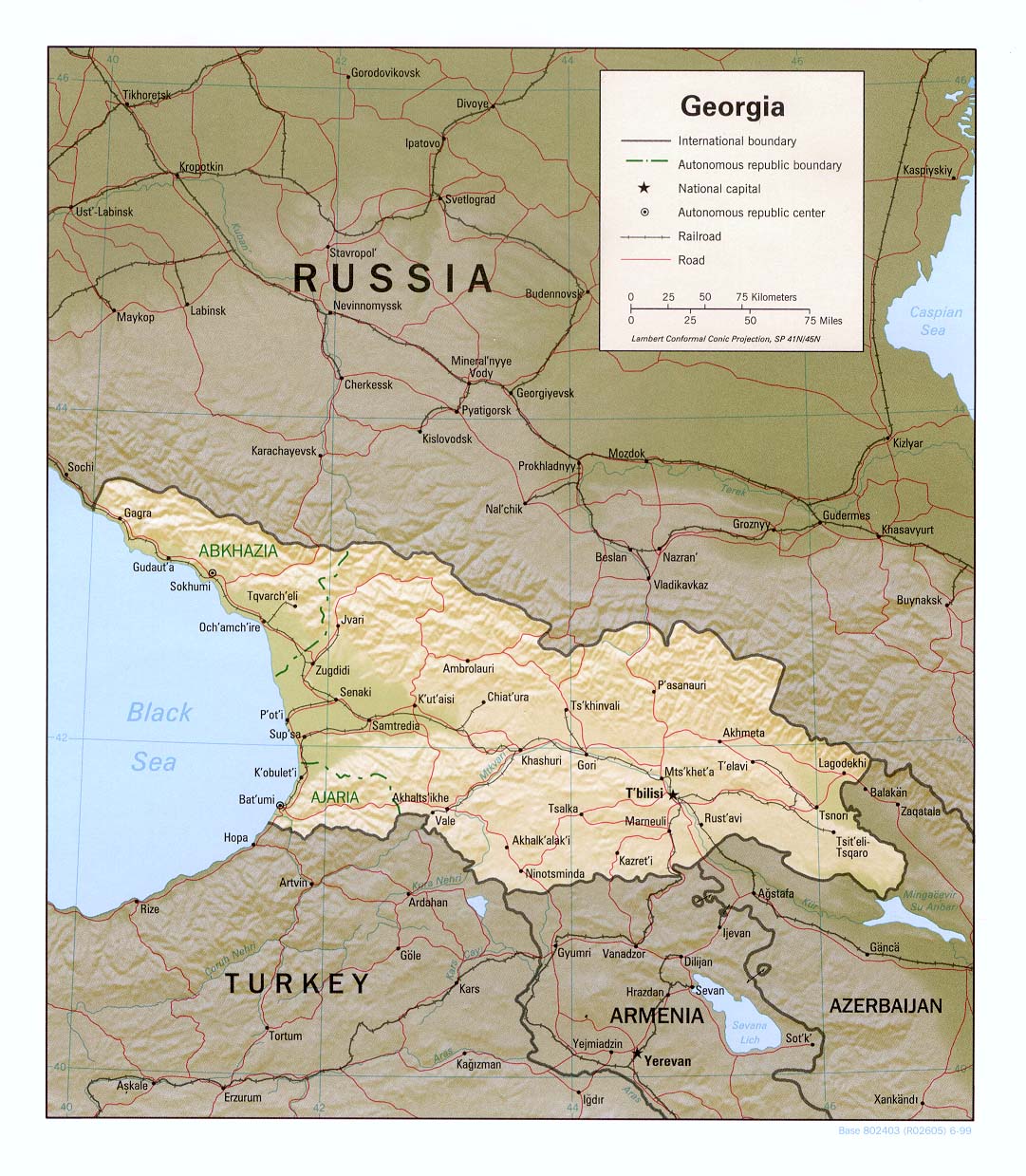
Justin Raimondo: Bailing out Georgia

This is from antiwar.com.
I find it truly amazing that U.S. citizens put up with what their own government does to them. This issue doesn't even seem to come up on the campaign trail from anything I have seen. Any expenses of U.S. imperialism are just translated into defence in the war against terror or against whatever bad guy is current on the scene in this case Russia. So while U.S. infrastructure crumbles and state governments face crushing deficits the US finds the money to rebuild Georgia! Of course many US companies some no doubt with ties to the Bush administration will profit from this billion dollar expenditure courtesy of US taxpayers.


Bailing Out Georgia
No, not our Georgia – the other one!
by Justin Raimondo
The US government is sending $1 billion to "rebuild" Georgia – no, not the Georgia located in the southern United States, where home foreclosure rates are double the national average, but the one located in the Caucasus, along Russia's southern frontier, where the President of the country launched a reckless invasion of a rebellious province, murdered thousands, and got his ass kicked by the rebels and their Russian protectors. Now we're sending him a billion dollars – by way of a reward.
Meeting in Brussels, Western donors pledged "more than $1 billion more than the World Bank's target." The announcement, as reported by the New York Times, "came as a financial crisis rattled the economies of donor nations. The United States pledged the largest amount, $1 billion over three years. An additional $642.8 million will be allocated by the European Commission over the next two years. Jose Manuel Barroso, the president of the European Commission, said the pledge should send ‘a strong signal to the world' that its members stand with Georgia. ‘The international community believes in and upholds certain values and norms of conduct, and those include the peaceful resolution of disputes,' Mr. Barroso said."
Who is sending a signal to whom – and for what purpose?
On the surface, none of this makes any sense. To begin with, all the damage to civilians and infrastructure was done by the Georgians. They bombed the city of Tskhinvali, capital of the rebel province of South Ossetia, destroying the city center, killing thousands, and rendering many thousands more homeless. Rebuild Georgia? It's the Ossetians who need the rebuilding – not that anything or anyone on this earth can rebuild their broken lives.
This is one humanitarian catastrophe that has gone completely unacknowledged in the West: indeed, justice is not only denied, but inverted: the Georgians, the villains in this instance, are being sent the aid. Sounds like an incentive to commit yet more aggression – not that Saakashvili needs any encouragement.
He refuses to include the Ossetians or the rebel Abkhazians in any negotiations, and his government has broken off meetings with the Russians over the terms of a peace accord. Faced with protests over his increasingly authoritarian rule, as well as a backlash against his hot-headed recklessness in starting the war to begin with, the region's star "democrat" and staunch US ally is even now maneuvering to launch yet another provocation against Moscow. It would be a welcome diversion from his growing internal problem.
With the West and much of the world undergoing a financial paroxysm of unprecedented proportions, what in the name of all that's holy are we doing sending a billion bucks to some godforsaken ex-Soviet republic on the edge of nowhere? The Europeans are sinking, too, and yet they're chipping in. What's the story?
The signal that is being sent here, both by the US and Europe, is that we will fight, if necessary, to extend Western influence into the Caucasus. The gauntlet is thrown – and Putin is sure to pick it up.
Some of the Europeans may be a little skeptical of admitting Georgia (and Ukraine) into NATO, but the US government and its European allies are giving the Georgian government unconditional support in its ongoing efforts to confront the Russians in their own "near abroad." The Russians, for their part, are acting much as we did when the French – still suffering from the aftereffects of the French Revolution in its Napoleonic phase– set up Maximilian I as "Emperor" of Mexico and threatened to extend their sphere of influence north of the Rio Grande.
This signal of support for Tbilisi is for the benefit not only of the Russians, and the Georgian government, but is also meant to reassure big Western investors who have already poured billions into the lucrative Ceyhan-Tbilisi-Baku oil pipeline, which is competing with the Russians in transporting oil from the central Asian ‘stans to the European market. The Western oil giants, locked out of the Russian market by Putin, are desperate to outflank the Russkies and bypass Middle Eastern suppliers. Billions in profits hang in the balance.
The CTB pipeline is yet another investment that is threatening to go south, bigtime, as regional tensions threaten to disrupt the free flow of oil over the troubled lands it snakes through. Like AIG, Bear-Stearns, and the rest of the lords of Wall Street, this concern is "too big to fail," and you can bet that the US government will take every possible action – including military action – to protect the banks who are underwriting the project.
As the response of Western governments to the financial meltdown makes all too clear, here in the West we have socialism for investment bankers and their partners-in-crime, and "free enterprise" for the rest of us, who work hard, pay taxes, and live by the rules.
Oh, but not to worry: they're rebuilding Georgia – with your tax dollars.
The costs are socialized, and the profits are privatized – that's what they call "democratic capitalism," or, in Europe, "social democracy." In both cases, foreign policy is merely an overseas projection of domestic political arrangements.
In detailing how the aid money is going to be spent, the Times' reporting on the donors' powwow implicitly rationalizes the expenditure:
"After hostilities broke out on Aug. 7, transportation routes from Georgia's main Black Sea port were cut off, and dozens of importers defaulted on contracts. The stock market plummeted, and Georgians made a run on banks, wiping out $165 million in deposits at the Bank of Georgia. The country's scenic Black Sea resorts, once popular with Russians, sit largely empty."
Hefty costs, but who ought to pay? Why, the perpetrator of the violence, namely Mikhel Saakashvili. Instead, he's being sent a big fat check. Welcome to the Bizarro World of American foreign policy.
As Mark Ames points out in The Nation, the evil-authoritarian-Russia-attacked-poor-little-democratic-Georgia narrative has been completely debunked – check out Der Spiegel's "Did Saakashvili Lie?" (short answer: yes). As Antiwar.com reported as the crisis broke out, and subsequent reports confirm, the evidence is indisputable that the Georgians attacked the Russians first, killing over a dozen Russian peacekeepers legally stationed in South Ossetia in the course of a massive and deadly assault on the Ossetian capital. Not that the Western media, so easily manipulated by Georgia's amen corner, is acknowledging their initial "error," as Ames notes.
"Ever since I went down to South Ossetia to see the war for myself, I'd developed a kind of sick curiosity to see just how the Times and all the others were going to extricate themselves from the credibility-hole they'd dug. I had a feeling it was going to come, because Saakashvili was not only a blatant liar but an incredibly bad liar. I was in South Ossetia at the close of the war – I saw the destruction that the ‘freedom-loving' Georgians wreaked, and the bloated, rotting corpses on the streets of the province's capital city, Tskhinvali – so I was particularly interested in how long the sleazy tale of good vs. evil would last, and how the major media would squirm their way out of their biggest journalistic fiasco since the Iraqi-WMD blooper. Would the Times let their ombudsman out of the cage for another fake apology? ‘Oops! Who'da thunk our esteemed newspaper coulda screwed up this big twice in a row, dragging America into yet another war all on account of our inability to do our job as journalists?! Look, we just want to say we're sorry and move on, m'kay? So, have you moved on yet? Because we have'."
The lies spread by the mainstream media in the service of the War Party are bought and paid for by the corporate sponsors of the Russia encirclement project that has been the linchpin of our adversarial stance toward Moscow since Yeltsin's demise and Putin's rise. Having failed to pulverize the shattered Soviet colossus into the smallest possible splinters, the Western powers are now confronted with what they regard as a "resurgent" and inevitably revanchist Russia – which means that the Russians are no longer dirt poor and ruled by gangsters with American bank accounts. It also means they aren't going to be pushed around in their own back yard – at least not without putting up a heckuva fight.
Whether South Ossetia is Georgian, Russian, or none of the above – why is this any of our business? Who among us is qualified to untangle the interwoven threads of claims and counter-claims, extending back over hundreds of years, and come up with a just solution to the question of what constitutes Georgian "sovereignty"? Certainly no one who works for the US government.
Before one penny of "aid" is sent to Georgia, we should be asking: who will get this money? The Times gives us a breakdown:
"The World Bank had estimated that Georgia would need $3.25 billion "to cover budget support, social sector support and infrastructure development." Most of the aid, roughly $3.7 billion, will go to social and construction programs. An additional $850 million will be invested in the private sector, where donors hope it will offset the sharp drop in foreign direct investment."
None of this money is going to South Ossetia: it is all being funneled through Saakashvili and his cronies, who would rather leave the shattered infrastructure of bombed-out Tskhinvali as it is today, a stark reminder of what may very well reoccur should the Ossetians persist in going their own way. If anyone rebuilds, it will have to be the Russians. The private sector aid will be used to buy up Georgian assets on behalf of Western corporate interests. The difference between the World Bank figure and the number announced in Brussels – nearly half a billion – will cover bribes, covert action operations carried out by Western intelligence agencies, and other incidentals.
When challenged, proponents of foreign aid programs invariably reply: yes, but look at the minuscule numbers! Why, foreign aid is less than one percent of the total overseas budget, including, one supposes, military expenditures – but so what? The point is that these programs do real harm, in most cases achieving the exact opposite of their intended purpose. And in this particular case, the entire package is premised on a lie, and a freshly debunked one at that. What's really going on here is that the West is rewarding Saakashvili for his recklessness, and inciting him to commit fresh assaults. This course guarantees war. ~ Justin Raimondo

Thursday, October 23, 2008

Justin Raimondo: The War Party Embraces Obama

So there you are. You have a "choice" between two war mongers. There is bipartisan support for a continuation of the aggressive PNAC program of imperial adventurism at a time when the national debt is soaring and the economy getting blood transfusions from the taxpayer. This is military Keynesianism on steroids. Vote for Nader or someone other than the main parties.


The War Party Embraces Obama
Just remember: you've been warned…
by Justin Raimondo
In the midst of a softball interview with Georgian President Mikheil Saakashvili, New York Times reporter Deborah Solomon hurls this zinger:
"For all your lofty talk about democracy, last November you shut down the opposition television station in Tbilisi."
To the oily Saakashvili, however, this is water off a duck's back:
"The interference with Imedi TV was an exception, not a rule. This action was taken during mass riots when Imedi TV started to incite overthrow of the democratically elected government. It should be noted that the government did pay damages."
Do you suppose it would be okay if the FBI barged into the offices of, say, MSNBC, wrecked the place, hauled Keith Olbermann and Rachel Maddow out of the studio bodily, and shut down the station – as long as "damages" were paid?
The station, by the way, which was the only televised platform for the Georgian opposition, has since been handed over to a regime-friendly front man, who just happens to be an American citizen. Damages were paid, indeed…
This is the regime defended by Barack Obama, as Solomon points out, as well as (unsurprisingly) John McCain, and that's hardly the only case of bipartisan fealty to a U.S.-supported dictatorship.
There's Afghanistan, for example, where a young aspiring journalist has just been spared the death penalty for circulating an article about women's rights, and given 20 years in prison instead. This is the government Obama wants to strengthen and sacrifice more American lives for. From the Los Angeles Times piece on the trial and conviction by Laura King:
"In a case that has illustrated this country's drift toward a more radically conservative brand of Islam as well as the fragility of its legal system, an appeals court today overturned a death sentence for a student convicted of blasphemy but sentenced him instead to 20 years in prison."
So at a time when the U.S.-supported government is moving rapidly toward a Taliban-type theocracy – even as that government moves toward some type of accommodation with the radical Islamic former rulers of the country – Obama is telling us we must pour more troops, more money, and more of our hopes into the Afghan front, which has supposedly been "neglected" by the Bushies.
No wonder he's been endorsed by none other than Ken "Cakewalk" Adelman, and given support (albeit indirectly) by any number of neocons, such as Charles Krauthammer – who, after pummeling Obama for weeks, has suddenly discovered the Democratic candidate is possessed of a "first-class intellect and a first-class temperament," which "will likely be enough to make him president." And what more proof does anyone need that Obama is a disaster in the making other than that Andrew Sullivan, the former warlord of the blogosphere, has not only endorsed him, but fallen head over heels?
Ken Silverstein – Harper's columnist and author of a new book that looks to be hilariously informative – is scared:
"McCain's foreign policy crew has quite a few cranks (William Kristol, to state the most obvious) and his policies are generally scarier than Obama's. Agreed. But having Powell and Adelman sign up with the Obama movement is about as uplifting as when Obama endorsed ballistic missile defense (the scaled down version of Star Wars) during the second debate. It's conservatives who should be cheering."
To which Sullivan adds: "Yes. And we are."
(((Shudder)))
These "conservatives," you'll note, are all of the neo- variety, including Christopher Hitchens, who has also jumped on the Obama bandwagon, because, as he quite accurately writes:
"On 'the issues' in these closing weeks, there really isn't a very sharp or highly noticeable distinction to be made between the two nominees, and their 'debates' have been cramped and boring affairs as a result."
Hitchens happily notes, also, that "the Obama-Biden ticket is not a capitulationist one," by which he means our foreign policy of trigger-happy aggression will carry on, as before, albeit fronted by someone with a more pleasing personality than the Great Decider.
And if you're wondering what motivated a good many of these dyed-in-the-wool warmongers to suddenly turn on a dime and come out for the supposed "antiwar" candidate, you'll be on the right track if you consider who else is rooting for him:
"Defendants in the classified-information case involving two former pro-Israel lobbyists are hoping a change in administrations next year will bring a fresh review of their prosecution, according to sources on the defense team. The next attorney general, who will be nominated by Barack Obama or John McCain, is expected to reconsider the case of former American Israel Public Affairs Committee staffers Steve Rosen and Keith Weissman, as part of general review of high-profile legal issues decided by the Bush administration.
"Sources on the defense team have speculated that a possible Obama nominee to head the justice system could be more receptive to pleas to dismiss the case."
Obama wants to invade Pakistan and flood Afghanistan with yet more U.S. troops, and he will likely let two spies who funneled top secret intelligence to Israel off scot-free. Why wouldn't the War Party be perfectly satisfied with the election? After all, they're done with Iraq, anyway. We're about to be invited to leave. And he's good – from their perspective – on the Russian question, which promises to be the key area of future neocon mischief-making.
Our war-birds are naturally migratory creatures, effortlessly moving from branch to branch, and party to party, with no compunction whatsoever about changing either their nesting habits or the color of their feathers, so long as their ultimate goal – promoting conflict, in whatever form – is achieved. Republicans, Democrats, independents, or whatever: it's the same program, with the same result – an America perpetually at war, defending and extending the frontiers of its empire, without regard for the costs, either financial or purely human.
Preoccupied as we are with the spectacle of "democracy" unfolding on the American stage, we fail to notice the contours of a new world conflict taking shape far from the media spotlight. From the steppes of Central Asia to the jungles of South America, the American colossus is being challenged by rising forces of nationalism, religious zeal, and sheer resentment of the heedless exercise of hegemonic power that is often mistranslated as "anti-Americanism." It will take more than the calm reassurances of Barack Obama to still these tides of discontent and rancor. If he defies the odds and actually makes it to the White House, Obama will merely put another face on the same old policies, albeit more friendly and less offensive to our own elites, who would rather not be so rudely confronted with the ruthlessness of their rulers.
As some of my readers may know, I recently moved to a small town in northern California, where antiwar feeling is high – and so is support for Obama. Everywhere I go I see Obama posters, bumper-stickers, etc. Why, just the other day, a gaggle of peace demonstrators gathered in the middle of the town's main street, holding up banners proclaiming their opposition to our government's foreign policy and their support for Obama. "Honk if you're for peace and Obama!" – and the resulting cacophony was audible for miles. I live next door to a couple that has festooned their home with peace signs, and their backyard is a veritable "peace garden," with peace signs sprouting up all over – and, yes, their car sports an Obama-Biden bumper-sticker. A house sign supporting the Democratic ticket has sprung up in their front yard, alongside the rhododendrons. I wonder how long it will take these well-meaning folks to become thoroughly disillusioned with their messiah. In the case of the more honest and intelligent, I give it a few weeks, a month or so at the outside. The rest, I'm afraid, will follow the Dear Leader to perdition…~ Justin Raimondo

US will bank Tik Tok unless it sells off its US operations

  US Treasury Secretary Steven Mnuchin said during a CNBC interview that the Trump administration has decided that the Chinese internet app ...